More about Liminalis........
Our Founder Rachel, battled anxiety for most of her life. PTSD. Trauma that she had learned to function around rather than through — because functioning was what was asked of her, and she was very good at doing what was asked.
She was anxiously attached in ways she didn’t have language for yet. In a relationship with a good man — a genuinely good man — and yet they were both in a deeply unconscious place. Circling each other with the best intentions and none of the tools. Held together by familiarity and by the shared inability to go any deeper.
She was numb in a way that is hard to describe to someone who hasn’t lived it. Not dramatically numb. Quietly numb. Capable.
Functional. And somewhere beneath it all — hollow.
Pleasure felt like something that happened to other people.
Aliveness felt like something she was always reaching for and never quite arriving at.
She knew there was more. She had always known. She just didn’t know how to get there.

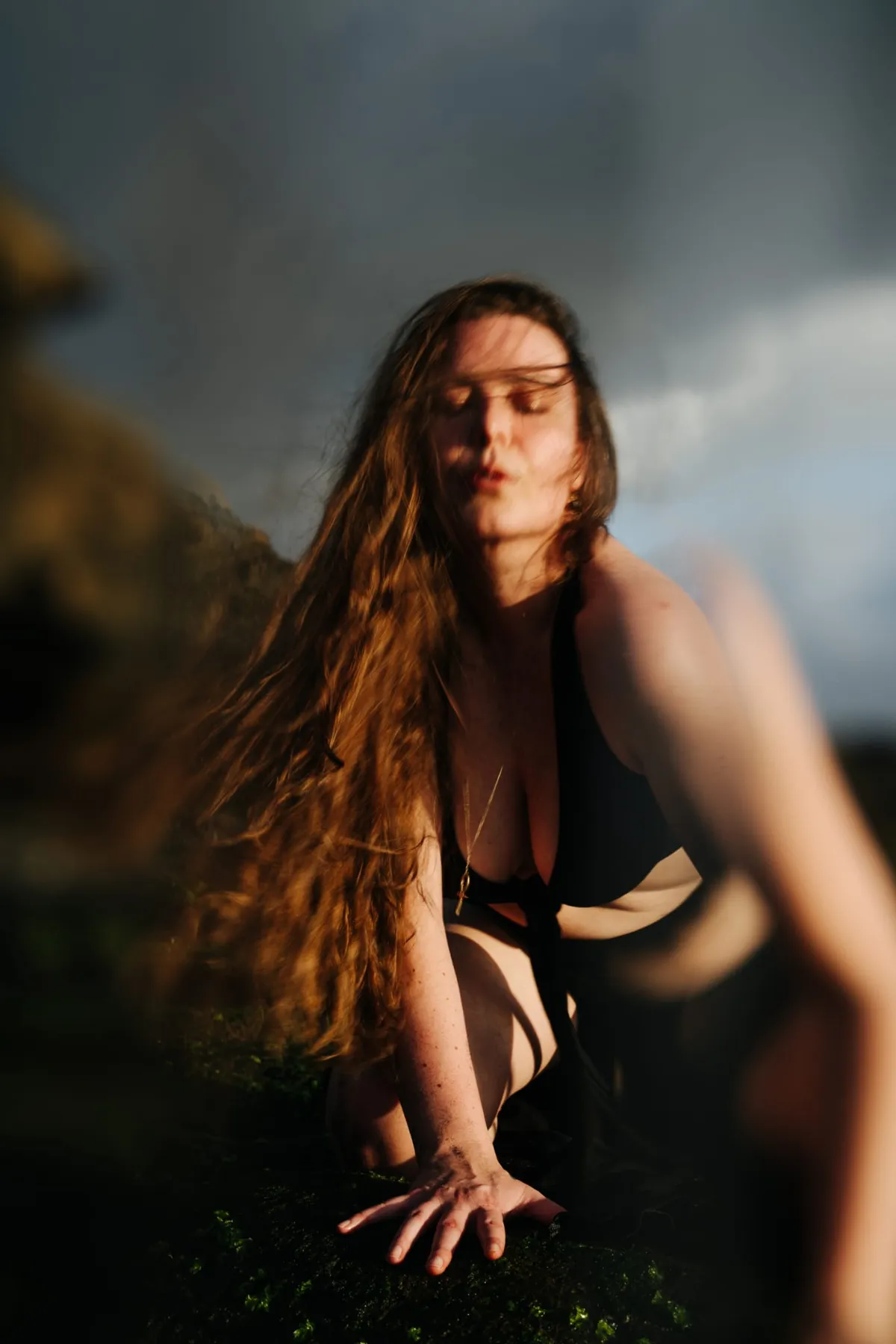
She came to tantra the way many people do — drawn by the promise of something more. More sensation. More access. More of whatever it was she had been quietly starving for without admitting it. And let’s just be honest and say it — orgasms. More of those too.
What she found cracked something open that she wasn’t prepared for.
Not in a dramatic, sudden way. In the slow, unrelenting way that real change actually happens. As she started working with tantra and sexuality, her old life began to unravel. The relationship. The identity. The carefully constructed version of herself that had kept everything manageable.
It felt like death.
Because it was. Old parts dying. Old ways of being that had kept her safe but had also kept her small. Old stories about who she was and what she was allowed to want and how much aliveness a person like her was permitted to have.
She wants to be honest about that part — because most people who talk about transformation skip it. They go straight to the arrival. They leave out the dying.
The dying is the work. The dying is where everything real begins.
— — —
She didn’t stop. She couldn’t.
She found the Self-Pleasure Modality — and in that work, something in her came home that hadn’t known it was waiting. Not just in her body. In her relationship with herself. A quality of presence, of inhabiting her own life, of fully inhabiting her body, of feeling — actually feeling — what was happening inside her rather than watching it from a careful distance.
It was through this work that she first encountered Victoria Bardovicc — the creator of the Self-Pleasure Modality, and the woman who would become her mentor and one of her closest friends. What began as a professional training became something far more personal. Rachel worked with Victoria both in her professional development and in deep personal process — and self-pleasure became a fundamental principle in her life from that point forward.
Not a technique. Not a practice she returned to occasionally. A way of navigating life itself. When moving through sensation, grief, uncertainty — needing to feel the direction her life was asking her to go — she has always returned to it.
She continued with processwork — the psychology of Arnold Mindell — which gave her a map for what she had been living. A framework for edges, for shadow, for the body’s signals, for the parts of us that are trying to become something we haven’t yet allowed ourselves to be. It allowed her to keep going into territory that she might otherwise have stopped at.
She became a sexologist. A processwork psychotherapist. A counsellor. Each training was not just a credential — it was another layer of the same work. Another depth. Another territory of self that she was finally willing to enter.
She trained. She travelled. She sat with teachers and in circles and in the quiet, unglamorous privacy of her own practice. She did what she now asks of others — not from a theoretical distance, but from inside the lived experience of it.
— — —
Then came the moment that started it all.
Through Eden Events — one of her combined ventures — Rachel facilitated a large group self-pleasure experience. What happened in that room stopped everyone. The grief that moved through people. The joy. The connection. The healing. The sheer, undeniable power of this practice held in a container that knew how to receive it. She was astonished — not because it surprised her intellectually, but because the room showed her something she hadn’t yet found language for: this work, at scale, in community, was something the world was desperately hungry for.
It happened again at a women’s transformational sexuality retreat shortly after.
And so she sent Victoria a voice note.
“I know it sounds crazy. But self-pleasure needs to be relaunched. And I need to do this.”
Victoria called her that same day.
She told Rachel that she was the one who was supposed to steward this modality. That she was the person to carry it forward.
A week later, the website was up. Enrolments were open.
— — —
What changed in Rachel is difficult to separate into parts, because it happened as a whole.
She came home to her body. Not as a peak experience — not a high that fades when the retreat ends — but as something anchored. Real. Hers. The body she had spent years managing and performing inside became something she actually inhabited.
The wildness she had always carried but never known how to hold — the creativity, the curiosity, the sheer aliveness of being a person in the world — stopped feeling like a problem to be managed and started feeling like the point.
The quality of intimacy available to her transformed. In love. In friendship. In the work itself. In the way she meets another person at the edge of what they can bear to look at. Something that had been held very tight for a very long time finally loosened — and what was underneath was not chaos. It was capacity.
She is not the same person who walked into that first tantra workshop searching for something she couldn’t name.
And she knows — from her own body, from years of this work — what becomes possible when you stop running from the parts of yourself that know.
— — —
That is why she built this school.
Not because she had the answers. Because she knows what it costs to stay numb, and she knows what becomes available when you don’t. Because there are people out there — searching, reaching, always feeling slightly out of place in a world that doesn’t quite hold all of what they are — and she knows that feeling from the inside.
She built Liminalis because this work changed her life in ways that nothing else touched. Because the sacred, the somatic, the sexual, and the scientific — fused together, held with rigour and reverence — is the most powerful container for human transformation she has ever encountered.
And because she is called to offer a transmission of what she has anchored in her own system. Not information. Not curriculum. A living, embodied transmission from someone who has actually been there.
I will stand for you, if you take a stand for yourself.
That is the promise she makes. That is the school she built.
WHY LIMINALIS — WHY THIS SCHOOL
There is so much available in this space right now. And so much of it is genuinely valuable. We honour the teachers, the lineages, the practitioners doing real work in the world.
What we offer is something specific. Something that took years to build, and that you won’t find assembled quite like this anywhere else.
A methodology with real roots.
The Self-Pleasure Modality™ and the broader suite of Liminalis courses and offerings are not assembled from trending wellness frameworks. They draw on sexology, Jungian depth psychology, processwork, tantric and sacred sexuality lineages spanning thousands of years, trauma-informed practice, and nervous system science — woven together into a coherent, teachable, clinically-informed framework. This is rigorous work. It has lineage. It has been lived before it was taught.
Clinical credibility and embodied depth — in the same room.
Rachel’s path into this work began in science — a Bachelor of Science and a career in forensic investigation that trained her to think with precision, hold complexity, and never accept surface answers when deeper ones were available. That rigour has never left her.
She is a PACFA accredited counsellor — a credential that requires years of supervised clinical practice, ethical accountability, and ongoing professional development. She is also a qualified sexologist — bringing a dedicated academic and clinical understanding of human sexuality that few practitioners in this space hold. She is a processwork psychotherapist, trained at one of the most progressive processwork institutes in the world. A trained tantric healer, with many years of mentorship under a tantric master. And since 2022, a certified Self-Pleasure Practitioner — not just someone who teaches this work, but someone who has been living it, in practice, every day since.
Most practitioners in this space come from one lineage or one discipline. Rachel brings a decade of parallel training across a broad range — and has spent years learning how to hold them together into something coherent, rigorous, and genuinely alive.
Personally chosen to steward this work.
The Self-Pleasure Modality was created by Victoria Bardovic. Rachel didn’t discover this work and build a business around it. She went through it herself, deeply and personally, over many years. She trained with Victoria professionally and worked with her in her own process. And when the time came, Victoria personally chose Rachel as the person to carry this modality forward. That is not a marketing story. It is a lineage.
Taught only by those who have gone there.
Every facilitator at Liminalis has done this work in their own body and their own life. Not as a training exercise — as a genuine personal journey. This is a non-negotiable condition of the work. You cannot hold space for someone in territory you haven’t entered yourself. We don’t ask it of our students without asking it of ourselves first.
The whole human — not a curated part of them.
We do not separate the sexual from the psychological, the somatic from the sacred, or the personal from the relational. The person who arrives wanting more pleasure will find themselves doing shadow work. The practitioner who arrives to certify will be changed by the process. We make no apology for that. It is, in our experience, the only way this work is real.
Honouring the erotic, the wounded, and the wildly whole
With curiosity, care and love xx
Rachel
(she/her)
Process-Oriented Psychotherapist | Sexologist | Integrated Wellbeing Specialist | Actor | Writer | Speaker | Lover and Creative
Founder, Liminalis School of Relational Arts
BSc | GradCertForSc | AdvDipLeadMgt | AdvDipTIPP
Liminalis Alumni
What our participants are saying...

