Self-Pleasure Modality™
A 12-Month Practitioner Certification
At a Glance
300 hours across 12 months
Four nationally recognised units toward a Diploma of Counselling, delivered in partnership with Pathways Psychology Institute (RTO 45397)
Internationally accredited modality, recognised by the International Institute for Complementary Therapists (IICT) — with graduates eligible for professional insurance through IICT
Accredited with the Somatic Sex Educators' Association of Australasia (SSEAA), with graduates eligible for SSEAA membership
Owned and taught by a lead facilitator who is an accredited Process-Oriented Psychotherapist, Sexologist, and PACFA-accredited Counsellor, bringing a clinical and scientific foundation to the training
Weekly 1-hour live teaching and supervision calls (with a 3-hour deep-dive session once a month, to allow the fuller pace processwork requires)
Weekly 1-hour dyad practice sessions with a partnered student
Self-paced online modules, available on your own schedule
Guest facilitators drawn from industry leaders across the sexuality, spirituality, coaching, and self-help fields
Open internationally, and to students of all genders
The final 2 months shift focus to dedicated business supervision and ongoing support, so graduates leave equipped to build a sustainable practice — not just certified
At its heart, the Self-Pleasure Modality™ teaches one thing: how to be present — with yourself, and with another. Everything else flows from there.
What Is the Self-Pleasure Modality™?
The Self-Pleasure Modality™ is the practice of descending awareness into the body and relating with the sensations being experienced, without attaching stories or meaning. Through the four tantric tools of sound, breath, movement and touch, sensations are given space to be expressed without judgment or censoring.
It is also something more than a practice. It is a technology for rewiring — safety, attunement, pleasure, and the fundamental ways we relate to ourselves and to others. Drawing from tantra and sacred sexuality traditions, somatic practice, nervous system and trauma science, depth psychology, processwork, and the ancient wisdom lineages that understood the body as a site of knowing long before modern medicine caught up — the Self-Pleasure Modality™ works at the level where all of these converge. In the body. In real time. In the living moment of sensation itself.
We have been taught to label and identify everything we feel — anger, rage, jealousy, sadness, happiness, pleasure, arousal — and to express ourselves according to what we perceive, consciously or unconsciously, as acceptable. The intention of the Self-Pleasure Modality™ is to relate to everything being felt in the body as sensation only — without the labels — and allow it to be expressed free of judgement. Through building relationship with the body’s sensations in this way, deep internal safety and nervous system regulation become not just possible but natural.
Over the course of a life, the expression of emotions, feelings, desires and sexuality are stifled, suppressed or censored — through trauma, conditioning, beliefs, dogma — causing energy to remain held in the body, resulting in numbness, tension, sexual dysfunction, disconnection, and many other physical and emotional ailments. This shapes not only how we experience pleasure, but how we show up in every relationship we inhabit.
Because what we do with ourselves in private, we do with others. The way we relate to our own sensation — whether we allow it or suppress it, stay with it or flee from it, trust it or override it — is the same way we will relate to intimacy, to vulnerability, to being truly known. The Self-Pleasure Modality™ addresses both. It begins with the self. It opens into everything.
The modality embodies listening — to the sensations being felt, to the body’s language, to what is present beneath the mind’s agenda. There is no goal other than to listen and allow.
What Happens in a Session
The Self-Pleasure Modality™ is both a personal practice and a professional methodology. Throughout the training you will develop both simultaneously — learning to inhabit the practice deeply in your own body, while also developing the skills to guide others through it. What you choose to do with that training — whether you use it purely for your own growth, build it into a professional practice, or both — is entirely yours to decide.
YOUR PERSONAL PRACTICE
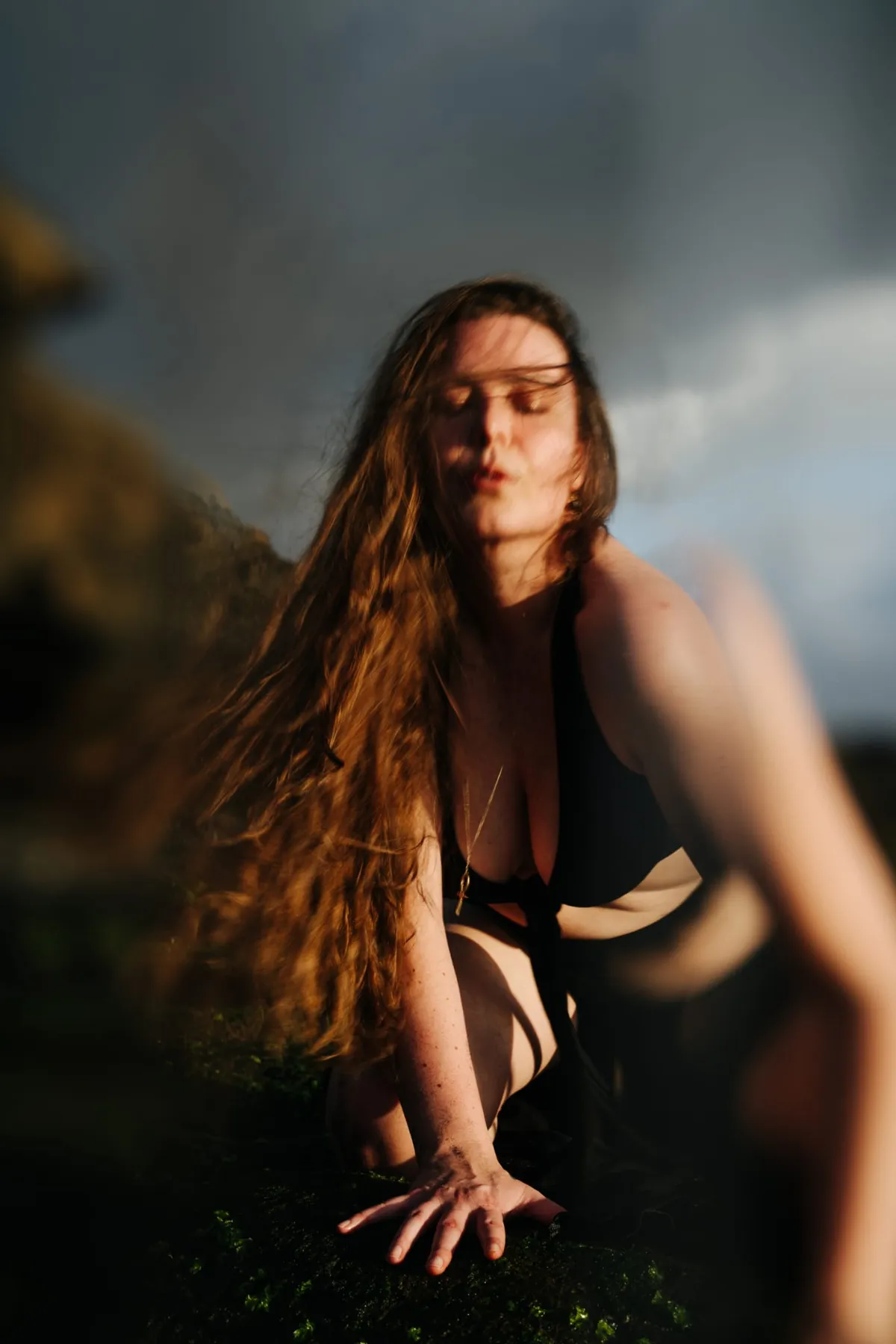
A session begins with arrival. You drop into what is present — what you are carrying, what you are curious about, what your body is holding. There is no script and no agenda. The practice is yours.
You are then guided into your Self-Pleasure practice. You are in complete control at all times and may pause or end at any moment. What the practice offers is a quality of presence and permission — to feel what is actually there, to allow sensation to move without labelling it, to stay with yourself in a way that daily life rarely makes possible.
What arises is different for everyone. Release. Awakening. Grief. Pleasure. Stillness. Sometimes simply the unfamiliar experience of being with yourself without performance or judgment.
The session closes with integration — speaking what arose, allowing the experience to settle into meaning, and drawing out intentions to carry into your life. Not goals in the conventional sense. Living threads that continue to work in you between sessions, in your relationships, in the quiet moments where the real shifts happen.

AS A PRACTITIONER
When you are guiding a client, the structure mirrors your own experience — because you will have lived it first.
The session opens with conversation. You meet your client in what is present for them — what they are moving through, what they want to explore, what has surfaced since you last worked together. From that conversation you orient the session — not from a formula, but from genuine atunement to where they are.
You then guide them into their practice. Your role is presence, not direction. You hold the space — attuned, responsive, non-directive — allowing the client to move at their own pace, in their own way. There is no physical contact at any point. The client is in complete control and can end the practice at any moment.
The session closes with integration. You hold space for the client to speak what arose, to make meaning, and together you draw out intentions and practices for them to carry into their life between sessions.
What you are developing as a practitioner is not a technique. It is a way of being — the capacity to be fully present with another person’s experience without needing to fix, direct, or interpret it. That capacity begins in your own practice. It is why both happen simultaneously throughout the training.
Going Deeper: Processwork in Practice
The intention of this practice is to bring you into connection with the innocence and purity of your lifeforce energy and expression. Not to create something new in you — but to return you to what was always there before the conditioning, the suppression, the years of performing yourself into shapes that kept you safe but kept you small. By allowing all sensations in the body to be felt and expressed — including the ones that are uncomfortable, unfamiliar, or have never been given permission before — more aliveness opens. And more pleasure becomes accessible, not just sexually, but across every dimension of life.
At the level of the nervous system, this practice is profoundly reparative. Many people have spent years in therapy, in personal development, in spiritual practice — and have still found themselves stuck in the same patterns, the same shutdowns, the same disconnection. That is not a failure of insight. It is because the body holds what the mind cannot think its way out of. The Self-Pleasure Modality™ works directly at the level of somatic experience — rewiring the nervous system’s relationship to safety, to sensation, to pleasure itself. The body learns, through direct experience repeated over time, that it is safe to feel. That it is safe to be here. That aliveness is not dangerous.
This practice also reaches the parts of self that most modalities leave untouched. The desires that were shamed. The expressions that were exiled. The erotic energy that was suppressed and either went numb or found its way out sideways — in disconnected sex, in compulsion, in the dull ache of a life lived at a fraction of its full current. The Self-Pleasure Modality™ does not pathologise these parts. It meets them with curiosity. It brings them home. And in that integration — that welcoming back of what was split off — something profound becomes available. A wholeness that is not performed but felt.
And because what we do with ourselves we do with others, the relational dimension of this work is inseparable from the personal. As you develop the capacity to be present with your own sensation — to stay rather than flee, to feel rather than manage — that same capacity begins to show up in your relationships. More genuine intimacy becomes possible. More depth. The ability to be truly known, and to truly know another, rather than two people performing closeness at a careful distance. This is not a side effect of the practice. It is one of its most profound gifts.
GOING DEEPER: PROCESSWORK IN PRACTICE
Presence is the foundation. Processwork is how you learn to follow it — with precision, and without imposing your own agenda onto what someone else's body is already trying to say.
Every graduate of the Self-Pleasure Modality™ trains in processwork psychotherapy and practice as a core, non-negotiable part of the curriculum — as the discipline that helps make presence teachable and repeatable rather than instinctual alone. This includes:
Core processwork theory — primary and secondary process, dreaming, and Mindell's three levels of reality (consensus reality, dreamland, and the sentient essence level
Edge work — recognising and respectfully working with the edges between a client's known and emerging identity, without ever pushing someone over an edge they aren't ready to cross
Signals and feedback — reading and amplifying verbal, non-verbal, and somatic signals, and learning to follow a client's feedback rather than your own agenda for where the session should go
Working across sensory channels — visual, auditory, interoceptive, and movement channels, plus the composite relationship and world channels, so you can meet a client in whichever channel their awareness is actually occupying
Applied practice through supervised, video-recorded exercises — including dreambody work, relationship work, and working with a body symptom, each conducted within a sexuality and self-pleasure–informed session context
This deeper practice isn't separate content taught in isolation — it's woven through the entire 300-hour program via the weekly live teaching calls, so it develops alongside your own embodiment work rather than as a bolt-on module.
Delivered in partnership with Pathways Psychology Institute (RTO 45397), this training also certifies you with four nationally recognised units towards a Diploma in Counselling (subject to meeting assessment criteria). The course is also designed so graduates can go on to meet the entry requirements for the Advanced Diploma of Trauma-Informed Processwork Psychotherapy with Pathways, without having to undertake their bridging course, should they wish to pursue further formal qualifications in counselling.
Benefits: How This Practice Changes Your Life
The intention of this practice is to bring you into connection with the innocence and purity of your lifeforce energy and expression. Not to create something new in you — but to return you to what was always there before the conditioning, the suppression, the years of performing yourself into shapes that kept you safe but kept you small. By allowing all sensations in the body to be felt and expressed — including the ones that are uncomfortable, unfamiliar, or have never been given permission before — more aliveness opens. And more pleasure becomes accessible, not just sexually, but across every dimension of life.
At the level of the nervous system, this practice is profoundly reparative. Many people have spent years in therapy, in personal development, in spiritual practice — and have still found themselves stuck in the same patterns, the same shutdowns, the same disconnection. That is not a failure of insight. It is because the body holds what the mind cannot think its way out of. The Self-Pleasure Modality™ works directly at the level of somatic experience — rewiring the nervous system's relationship to safety, to sensation, to pleasure itself. The body learns, through direct experience repeated over time, that it is safe to feel. That it is safe to be here. That aliveness is not dangerous.
This practice also reaches the parts of self that most modalities leave untouched. The desires that were shamed. The expressions that were exiled. The erotic energy that was suppressed and either went numb or found its way out sideways — in disconnected sex, in compulsion, in the dull ache of a life lived at a fraction of its full current. The Self-Pleasure Modality™ does not pathologise these parts. It meets them with curiosity. It brings them home. And in that integration — that welcoming back of what was split off — something profound becomes available. A wholeness that is not performed but felt.
And because what we do with ourselves we do with others, the relational dimension of this work is inseparable from the personal. As you develop the capacity to be present with your own sensation — to stay rather than flee, to feel rather than manage — that same capacity begins to show up in your relationships. More genuine intimacy becomes possible. More depth. The ability to be truly known, and to truly know another, rather than two people performing closeness at a careful distance. This is not a side effect of the practice. It is one of its most profound gifts.
As a practitioner, this also means:
You leave equipped to work with clients on pleasure, embodiment and sexual wellbeing from a clinically-grounded, trauma-informed foundation — not just a wellness framework
You hold nationally recognised units alongside your certification, giving your practice a level of credibility a coaching-only certificate can't offer
You have two full months of dedicated business supervision after your certification training — pricing, positioning, and client work, genuinely supported rather than left to figure out alone
You've had a full 12 months to integrate the material at a pace that lets it actually land, rather than rushing module to module
THE CORE
Learning to be with yourself. And then learning to be with another.
Not fixing. Not performing. Not achieving. Just — being present with what is alive in the body, without flinching away, without reaching for a story to explain it. The radical, quietly revolutionary act of staying.
Everything else — the nervous system regulation, the healing of trauma, the awakening of pleasure, the dissolution of numbness — is the fruit of that one practice. Of coming home to sensation. Of trusting the body's language over the mind's agenda.
What makes this distinct from sex therapy, from tantra, from somatic bodywork, from coaching — it doesn't just address the symptom or teach the skill. It rebuilds the fundamental capacity for presence.
The body already knows. The practice is learning to listen.
WHAT'S INCLUDED
300 hours of training across 12 months — weekly live teaching and supervision calls (including monthly 3-hour deep-dive sessions), weekly dyad practice, and self-paced online modules
The full Self-Pleasure Modality™ curriculum — processwork theory and practice, nervous system work, and somatic practice, every graduate trained to the same standard
Processwork training embedded throughout — edge work, signals and feedback, sensory channels, and applied dreambody, relationship, and body-symptom work
Four nationally recognised units delivered in partnership with Pathways Psychology Institute (RTO 45397), built into the core certification for every student
International accreditation with IICT, and accreditation with SSEAA — with eligibility for SSEAA membership and IICT professional insurance
Full course materials and an assignment schedule, including the supervised, video-recorded practice sessions required for certification
Meets entry requirements for the Advanced Diploma of Trauma-Informed Processwork Psychotherapy with Pathways, for graduates who wish to pursue further formal counselling qualifications
Two months of dedicated business supervision and ongoing support in months 11–12, so you graduate ready to build a practice, not just hold a certificate
Full certification as a Self-Pleasure Modality™ Practitioner on completion — one unified pathway, no tiers
Investment
$16,500 AUD on a payment plan $14,999 AUD paid in full (save $1,501)
Rachel’s evolution at work
The Self-Pleasure Modality™ was created by Victoria Bardovic as a precise and profound path for coming home to the body. Its core — the devotion to sensation over story, to presence over performance, to the wisdom of the body over the agenda of the mind — remains the foundation of everything taught here.'
Rachel Rowlatt now continues the Self-Pleasure Modality™, continuing to build on it, evolve it, and grow it. What began as Victoria's original creation is, under Rachel, a living body of work — added to, refined, and expanded as Rachel's own clinical practice, training, and lived experience deepen it further.
Rachel came to this work the way most people come to the things that end up defining their life — not through a plan, but through necessity. A forensic scientist and military veteran with a mind trained for precision and evidence, she was also a woman who had been cracked open by her own experience — of grief, of the body, of what happens when you stop managing your life and start actually feeling it. That combination — rigour and surrender, science and soul — is not common. It is what she brings to everything she touches, and it is what she brings to this.
She holds credentials that are rare in this space and rarer still in combination: sexologist, processwork psychotherapist, PACFA-accredited counsellor, tantric practitioner, doctoral student in clinical sexology, and international presenter in sexual health. Not one lens but many — and the wisdom to know when to use which one, and when to put them all down and simply be present.
She was personally chosen by Victoria Bardovic — the modality's original creator — to carry the work forward. That is a direct transmission. A lineage. It carries something that no curriculum alone can replicate, and she has since taken full ownership of the work, continuing to shape and expand it in the years since.
And she has lived this practice. Not as a professional exercise but as a fundamental principle of her own life — returning to it through grief, through uncertainty, through the moments where she needed to feel the direction her life needed to take. She has witnessed its power in intimate one-to-one sessions and in large group experiences through Eden Events and transformational retreats. She knows what this practice does to a room full of people. She knows what it does to a single person, alone with themselves for the first time in years.
The Self-Pleasure Modality™ as Rachel has built it forward is the same river — running deeper, running wider, fed by more tributaries than it has ever held before. What she is building through Liminalis is not just a certification. It is a field. A community. A new conversation about what it means to be fully human, fully alive, and fully in relationship — with yourself and with others.
When you enrol, you are not just enrolling in a modality. You are entering a lineage — one that continues to grow. And you are choosing to be guided by someone who has not only walked every step of this path — but who now owns it, shapes it, and carries it forward.
Self Pleasure Modality™ Practitioner Certification
Starts on 27.03.27
PAY UPFRONT
$ 14,999.00
Self Pleasure Modality™ Practitioner Certification
Starts on 27.03.27
PAYMENT PLAN
$ 16,500.00
The Self-Pleasure Modality™ Certification is delivered by Liminalis — School of Relational Arts, in partnership with Pathways Psychology Institute (RTO 45397) for the nationally recognised units embedded in the curriculum.
Self Pleasure Modality™ Practitioner Certification PLUS
$ 15 499.00
This is a Paragraph Font
The Pathways Stream is an option within the Self-Pleasure Modality™ Certification, delivered in partnership with Pathways Psychology Institute (RTO 45397), for students who want their processwork training formally recognised toward a counselling qualification. All SPM™ students receive the same core curriculum and graduate fully certified regardless of stream, but Pathways students go deeper into processwork psychotherapy and practice — covering edge work, signals and feedback, work across sensory channels, and applied dreambody, relationship, and body symptom exercises — and complete the additional assignments, reading, and coursework required to earn formal certification in four nationally recognised TAFE units toward a Diploma of Counselling. This also meets the entry requirements for Pathways' Advanced Diploma of Trauma-Informed Processwork Psychotherapy, for graduates who want to pursue further formal study. The stream asks more time and investment ($3,500 AUD additional) than standard training, and exists purely for those seeking that extra scope and accreditation — not as a marker of a lesser standard training path.
Liminalis Alumni
What our participants are saying...

